1. Extraversion vs Introversion: What’s the Difference?
2. Psychological functions: perception of invariants (sensation), perception of change (intuition), feeling, thinking
3. Model of Consciousness: Structure, Functions and Types
What are psychological functions?
In psychology, four basic functions are usually distinguished:
sensation, intuition, thinking, and feeling.
But behind this list lies a more complex structure.
Psychological Functions
Basic Concepts
After identifying two fundamental attitudes of consciousness toward the object, Carl Jung distinguished four basic psychological functions:
- sensation (German: Empfindung),
- intuition (German: Intuition),
- feeling (German: Fühlen),
- thinking (German: Denken).
Each of the four basic functions can manifest itself in two attitudes: extraverted and introverted. Accordingly, eight functions are distinguished:
- extraverted intuition, Ne,
- introverted intuition, Ni,
- extraverted sensation, Se,
- introverted sensation, Si,
- extraverted feeling, Fe,
- introverted feeling, Fi,
- extraverted thinking, Te,
- introverted thinking, Ti,
where the letters e and i denote the attitude, and N, S, F, and T denote the basic function.
According to Jung, sensation and intuition are irrational functions, whereas feeling and thinking are rational functions, from the Latin ratio — reason, rational judgment.
The irrational functions apprehend the object as given in reality.
The rational functions form judgments about reality, and these judgments correspond to the attitude:
in the extraverted attitude, the significance of the object is affirmed; in the introverted attitude, the significance of the object is diminished.
Irrational Functions — Functions of Perception
The term perception, as used here, does not correspond to perception in the usual psychological or physiological sense.
In this text, perception is not understood as sensory processing, information intake, or stimulus registration. Rather, it designates an act in which something is taken as real.
More precisely, perception refers to:
the taking-as-real of what presents itself.
Perception is therefore not “received data,” but an act of acknowledgment:
This is acknowledged as having reality.
This is accepted as real.
Thus, perception is not merely a function of the senses or of the psyche, but an act in which what appears is affirmed as reality.
Why Perception Is Difficult to Define
In contemporary English, the word perception is largely neutral and technical. It is closely associated with sensory mechanisms and cognitive processing, and therefore often lacks ontological weight.
However, in the present model, perception already implies an act of acknowledging reality.
It is not merely the functioning of the senses or of cognition, but an act in which what presents itself is taken as real.
For this reason, throughout this text perception should be understood as:
– the taking-as-real of what presents itself,
– the acknowledgment of what appears as real.
These formulations avoid both physiological reduction and metaphysical claims about objective truth.
Perception of Invariants (Sensation) and Perception of Change (Intuition) as Two Modes of Perception
Perception of invariants (sensation) and perception of change (intuition) are two different modes of perception.
They are not forms of processing or interpretation. They are modes of direct contact with reality.
Perception of invariants and perception of change are opposed to one another, but their opposition is not a matter of conflict. It is an opposition of complementarity.
Their opposition means that they articulate one and the same reality according to different principles.
Perception of change apprehends the content of reality in the aspect of change.
Perception of invariants apprehends that which in the object remains constant and self-identical.
- If, from the total apprehension of reality, everything that changes is left out, what remains is the content of perception of invariants.
- If, on the contrary, everything stable and constant is left out, what remains is the content of perception of change.
Both functions perceive the object and it actions over time:
- perception of change abstracts from what remains the same and apprehends change,
- whereas perception of invariants abstracts from change and apprehends what is identical with itself.
Thus, the two opposite functions do not exclude one another. Taken together, they exhaust the possible contents of perception and form the fullness of perceptionc
On the Difference in the Understanding of Intuition
In classical Jungian typology, intuition is defined primarily by the source of its contents, namely as perception mediated by the unconscious. As a result, intuition in Jung’s work is often closely associated with the unconscious itself.
In the present approach, the emphasis is shifted from the source of intuitive contents to the mode of articulation of reality — that is, to which aspect of being is apprehended as the object of perception.
Intuition is understood here as the apprehension of change and becoming, whereas sensation apprehends what is stable and self-identical in the object.
Accordingly, intuition is not identified with the unconscious as such. Intuition can be either conscious or unconscious; its essential nature does not lie in this distinction.
Irrational Functions and Reality
In Jung’s terminology, sensation and intuition are called irrational functions. This does not imply anything chaotic or illogical.
“Irrational” here simply means that these functions do not form judgments. They do not evaluate, affirm, or deny significance.
They perform perception — the taking-as-real of what presents itself.
Renaming the Irrational Functions
In the present work, the perceptual functions are deliberately renamed as Perception of Invariants (traditionally called Sensation) and Perception of Change (traditionally called Intuition).
This renaming is introduced in order to make their essential nature explicit. It also serves to prevent their meanings from being conflated with the everyday usage of the terms “intuition” and “sensation,” as well as with Jung’s own understanding of these functions.
In these new terms, the focus shifts to which of two opposing and complementary aspects of reality is perceived by the given function: either that which remains unchanged and identical to itself — this is the Perception of Invariants; or that which changes — this is the Perception of Change.
Rational Functions: Thinking and Feeling
In contrast to the irrational functions, which perform perception — the taking-as-real of the object — the rational functions form judgments about the object.
Thinking
Thinking is the formation of conceptual judgments expressed in language (verbal or symbolic).
Inner speech is a form of thinking.
The most complete and precise definition of thinking is: the formation of information.
Information is knowledge about things, facts, concepts, instructions, and so on, represented in a form suitable for interpretation, communication, and processing.
The content of extraverted thinking is information about concrete objects.
In introversion, abstraction from the object occurs; introverted thinking is abstract thinking.
Examples of introverted thinking: solving mathematical problems, thinking through chess moves.
Examples of extraverted thinking: evaluating a product in a store, accounting, planning the interior of a room, reading a map of an area, rules of etiquette, traffic rules.
Feeling
Feeling is also a judging function; however, unlike thinking, the judgment is not expressed in concepts.
Feeling represents an evaluation — acceptance or rejection — without verbal form. It is a binary evaluation of the object (acceptance/rejection), without scale or quantitative gradation.
Extraverted feeling is positive toward the object; it enhances its value. Introverted feeling, by contrast, withdraws libido from the object and diminishes its value.
The Opposition of Thinking and Feeling
Thinking and feeling relate to the same object or process; however, they exclude each other, as they cannot be realized within the same act of judgment.
At each specific moment of judgment, either the thinking function or the feeling function is active. If the thinking function is activated, the feeling function is deactivated, and vice versa.
Feeling remains where inner speech comes to a halt. However, the ability to interrupt inner speech is not equally accessible to all psychological types.
The Difference Between the Four Psychological Functions
The psychological functions differ in their fundamental mode of relating consciousness to reality. They generate different types of psychic content and articulate reality according to different principles.
Feeling
→ evaluation without words
→ binary evaluation
→ acceptance or rejection as an immediate act
Thinking
→ conceptual determination
→ classification (“This is a fork,” “This is an inanimate object”)
→ judgment
→ justification, argument, criterion
Perception contains neither positive nor negative relation; it neither approves nor rejects (in contrast to feeling).
Nor does perception contain concepts expressed in words, signs, or formulas; it does not name (in contrast to thinking).
Orientation of Consciousness and the Connection of Functions
An irrational function provides the perception of the object in time.
A rational function provides a judgment about the object.
The connection of functions is possible only between a rational and an irrational function and means that perception and judgment relate to the same object.
The orientation of consciousness is possible only through the presence of two complementary acts: the perception of an object and a judgment about its significance.
In perception without judgment, the subject does not know what what is happening means for them.
In judgment without perception, the object of judgment is either remembered or imagined; the absence of perception means the absence of feedback from reality and the impossibility of verifying the judgment against reality.
Feeling and Affect (Emotion)
It is important to emphasize: feeling is not emotion.
Jung uses the term affect (or emotion) to designate a state in which the content of feeling merges with the content of other functions and is accompanied by pronounced bodily reactions (for example, muscle tension, changes in breathing, vegetative reactions).
In affect, consciousness is filled with undifferentiated functions fused together.
In affect there may be fragments of perception, fragments of feeling, or fragments of thinking, but not in the form of differentiated elements of functions; rather, as unstructured, undifferentiated content.
Differentiation of the Function
“Differentiation consists in the separation of a function from other functions, as well as in the separation of its individual elements from one another.”
An element is a distinct part of the content of a function, separated both from other parts of the same function and from other functions.
According to Jung, when an element of a function is formed, the content of the opposite function is thereby segregated as undifferentiated.
The content of a differentiated function consists of elements. An undifferentiated function does not form elements; its content is fused both within itself and with other functions.
An undifferentiated function may nevertheless be conscious. A function is considered conscious when the subject understands what kind of orientation is required in a given situation and what expectations are associated with it.
“As a rule, the undifferentiated function is characterized by ambivalence and ambitendency; that is, every position noticeably carries its negation within it, which gives rise to characteristic inhibitions in the use of the undifferentiated function.”
Consequently, despite conscious intention, the subject is not capable of carrying out the corresponding act of orientation.
The Dominant and the Auxiliary Function
The hierarchy of functions rests on structural asymmetry → learn more: Asymmetry as a fundamental principle of life
Jung discovered that one function — the most differentiated — determines the orientation of consciousness and called it the dominant function.
The elements of the dominant function are formed spontaneously, as an autonomous process of consciousness that is not subject to conscious control.
Psychological types whose dominant function is rational are called rational types; those whose dominant function is irrational are called irrational types.
Jung wrote that alongside the dominant function there must be in consciousness another differentiated function, which he called the auxiliary (and sometimes the secondary) function. Since both the dominant and the auxiliary functions must be conscious, they are either both extraverted or both introverted.
If the dominant function is irrational, the auxiliary function must be rational — either feeling or thinking (in the same attitude as the dominant function). If the dominant function is rational, the auxiliary must be either perception of change or perception of invariants. If both the dominant and auxiliary functions belong to the same class (both rational or both irrational), the act of orientation of consciousness becomes impossible, since the complementarity of perception and judgment disappears.
In rational types, the formation of judgment precedes perception of the object: the object is perceived in accordance with already existing a priori judgment. This is precisely the kind of perception Jung called “subjectively colored” or “dependent on the subjective factor.” If the auxiliary function is introverted perception of invariants (Si) or introverted perception of change (Ni), the object is perceived as abstract (in the case of leading thinking Ti) or as negatively evaluated (in the case of dominant feeling Fi). If the auxiliary function is extraverted perception of invariants (Se) or extraverted perception of change (Ne), the object is perceived as concrete, with qualities belonging to it alone (in the case of dominant thinking Te) or as positively evaluated (in the case of dominant feeling Fe).
In irrational types, the dominant function in both attitudes perceives the object without evaluation, without prejudice, more “objectively,” independently of the “subjective factor.” The letters i and e in this case designate only the general (dominant) attitude of consciousness.
Attitude (extraverted or introverted), dominant function, and auxiliary function completely determine the type and define the arrangement of functions in the model of consciousness. Therefore, types will be designated by three Latin letters: the first letter E or I denotes the attitude; the second denotes the dominant function; and the third denotes the auxiliary function, where S, N, F, T denote perception of invariants, perception of change, feeling, and thinking respectively.
The Right and Left Secondary Functions
Two functions can formally claim the role of auxiliary (we shall call them secondary). For rational types these are perception of invariants and perception of change; for irrational types — thinking and feeling. However, of these two mutually opposed functions only one is differentiated; both are conscious and can, unlike the dominant function, be engaged deliberately.
We shall call these two secondary functions, according to their position in the scheme, the left secondary (undifferentiated) and the right secondary (auxiliary, differentiated).
The diagram shows the functional scheme for the introverted type with dominant thinking and auxiliary perception of change — type ITN. This scheme is derived from the general model of consciousness.
Circles represent differentiated functions; “clouds” represent undifferentiated ones. Dotted lines denote spontaneous, non-conscious activation of functions; arrows denote conscious activation.
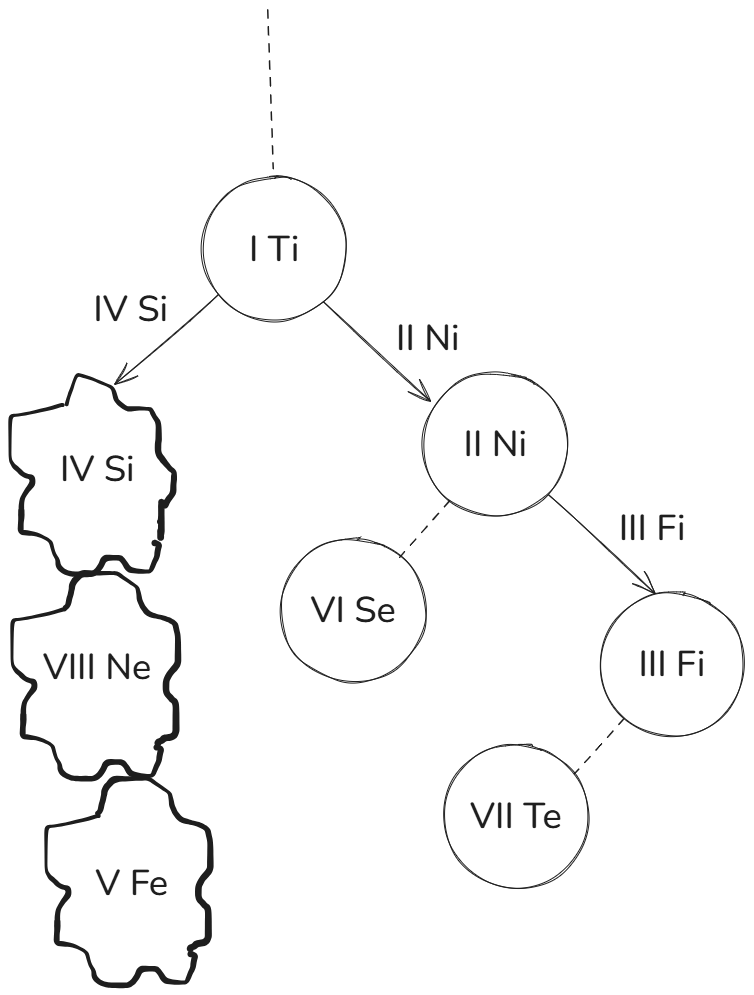
The two secondary functions of type ITN can be activated alternately. This means that if introverted perception of change Ni (the right secondary / auxiliary function) is active, then introverted perception of invariants Si (the left secondary function) is inactive — Si is “switched off,” and the entire left block (which we have called the left path) is inactive. If introverted perception of invariants Si is active, introverted perception of change Ni is inactive, and with it the entire chain of differentiated functions.
Transitions from the left path to the right, and back again, are discrete and always possible.
On the right path, all four functions are present:
- thinking (the dominant function) in two attitudes: Ti and Te,
- perception of change in the introverted attitude Ni,
- perception of invariants in the extraverted attitude Se,
- feeling in the introverted attitude Fi.
All functions on the right path are differentiated, and thinking, as the differentiated function, is present even in two attitudes.
On the left path, all four functions are also present:
- thinking in the introverted attitude Ti (leading function),
- perception of invariants in the introverted attitude Si,
- perception of change in the extraverted attitude Ne,
- feeling in the extraverted attitude Fe.
However, on the left path only one function — the dominant one — is differentiated. The other three functions are undifferentiated, that is, fused in their parts and with one another.
On the left path arises what Jung called one-sided development of the dominant function and imbalance. Prolonged functioning with undifferentiated functions increases the risk of neurotic states.
Memory and Imagination
The content of psychological functions is formed from material supplied by the environment. The environment may be rich or poor, and upon this depends the number of elements of the dominant function (and, on the right path, the number of elements of the other three functions as well).
The content of functions can be preserved in memory, and in recollection the psychological functions operate upon this content (both in extraverts and introverts). Recollection is always reconstruction. Imagination likewise operates upon the content of memory.
Remembered or imagined objects are elements of the irrational functions (perception of invariants and perception of change), whereas judgments about these objects are elements of the rational functions (feeling and thinking). With each act of remembering, the elements are recombined and may vary.
In rational types, elements of judgment and/or evaluation are “selected” from memory first, and only afterwards elements of perception that correspond to these judgments and/or evaluations. Therefore, recollections in rational types may sometimes appear distorted, with omissions or exaggerations.
In irrational types, memory and imagination may be richer in detail. As in rational types, memory errors are possible.
Since imagination operates upon the same material as memory, and recollection is an active reconstruction, the risk of distortion increases the more flexible and adaptive imagination is.