Psychic Energy and Its Movement: Flow and the Psychological Field
Below, in green text, quotations from the book “Love. The Secrets of Unfreezing” by Marina Komissarova are presented.
How does falling in love arise?
This occurs due to a phenomenon that in psychology is called “cathexis”.
This term was introduced by Sigmund Freud (1856–1939), an Austrian psychologist and neurologist, and he used it to mean literally a “occupation with energy”.
In dynamic psychology, this word means “striving”, “strong interest”, “occupation”.
When a person becomes interested in something, they give away part of their energy. But not to the things themselves, rather to the projections of those things in their field. They “cultivate” a figure in their field, as Gestalt psychologists later called it.
My note: thing = object.
More on this: → Object and Subject
However, long before Freud, this phenomenon was already known and was described in a similar way by ancient occult thinkers.
For example, Heinrich Cornelius Agrippa (1486–1535) wrote:
“Democritus, Orpheus, and many Pythagoreans, who carefully investigated the properties of heavenly and lower bodies, said that everything is full of gods… The occultists called gods the divine properties distributed in bodies. These properties Zoroaster calls attractions, Synesius calls seductions, other authors call vital forces, and still others call souls, on which the properties of things depend, and which, according to their properties, spread in each body the matter of the one world soul. Thus, when a person knows a thing, they as if transfer part of their soul into this thing, and the thing, in turn, arises in their imagination. The occultists say in this case that a part of the soul, having left one being, enters another and enchants it, hindering its actions, just as a diamond prevents a magnet from attracting iron.”
My note:
In the terms of Carl Gustav Jung, a person who transfers part of their soul into an object is an extravert.
A person, on the other hand, who resists the “occupation” of their energy by an object is an introvert.
As Jung showed, in one and the same person there operate both a movement of energy “outward” (extraverted) and “inward” (introverted).
However, one direction always dominates and orients consciousness in relation to the object.
More on this: → Extraversion and Introversion
Everything that awakens interest in a person and attracts their attention possesses attractive (divine) properties in their field. This thing (or this person) activates in them a “current of the soul”, a flow of energy, as a result of which the person feels better and more “life” appears in them.
The term “energy” was first introduced by Aristotle (384–322 BC) in “Physics”, where he meant activity, movement.
Many psychologists, for example Alexei Leontiev (1903–1979) and Gordon Allport (1897–1967), were of the opinion that a person’s personality can be entirely reduced to their activity.
The English physicist Thomas Young (1773–1829) recalled the Aristotelian term and reintroduced it into physics.
And about 100 years later, the Swiss psychologist Carl Gustav Jung (1875–1961) described human energy as an interest directed toward something.
Energy is “allocated” to a person by their own brain: it produces dopamine and other substances responsible for the increase of energy.
However, the brain does this only when something interests the person. The stronger and the longer the interest, the more energy is released. People who are passionate about something radiate energy. However, they may also become exhausted if at some point their brain detects the futility of their efforts.
Even at the neurochemical level, the production of dopamine, which is responsible for motivation, depends on endorphins, which are responsible for the feeling of satisfaction with the result.
In apathy, the brain releases very little energy. The person feels shapeless and indifferent to everything. In a state of emotional uplift, on the contrary, there is a lot of energy — this is familiar to anyone who has experienced at least once a surge of motivation, inspiration, or passion.
Ancient occultists spoke of the existence of subtle fields in which a parallel life of a person unfolds, influencing their physical existence. Such spaces, in the understanding of the ancients, were filled with various entities: gods, spirits, elementals, on which the fate of a person depended.
Such a level cannot be simply regarded as a level of imagination, although imagination plays a role in it. In addition to one’s own imagination, many different forces take part in the formation of this level.
Note: These forces, in my view, are psychological functions — namely one’s own psychological functions, and nothing else that would stand between the object and its image in the psyche.
Today this level is called the “psychological field”, and many of its laws have been described.
Note: The question is whether the “psychological field” is an independent reality — or merely a way of describing the activity of the psyche.
Vladimir Bekhterev (1857–1927), a Russian psychiatrist and physiologist, wrote that between the psyche as a function of the brain and the actual activity of the psyche (thinking, behavior) there lies a mysterious field in which various events unfold that influence the activity of the psyche. This is a separate reality that should not be confused with what happens in a person’s life, although a person’s life depends on this reality.
Note:
It is unclear why the assumption of a “psychological field” as an independent entity between the function of the brain and the activity of the psyche should be introduced.
The “psychological field” is filled with images of objects, where by “objects” things of the real world are meant.
The activity of the psyche itself is this “psychological field” that stands between the function of the brain and the objective world.
It consists in forming a world model.
According to Carl Gustav Jung (1875–1961), in this psychic activity four fundamental forms can be distinguished — four fundamental psychological functions.
Jung writes:
“By psychological function I understand a certain form of psychic activity that, under different circumstances, remains in principle the same.”
More on this: → World Model and Psychological Functions – How Consciousness Models the World
The various events that influence the activity of the psyche take place in the real world (and our body also belongs to the real world).
Two Models of the Interaction between Subject and Object
🔹 Model A: Psychological Field (after Komissarova)
A person can work with what fills their psychological field, and this field will influence what happens to them in reality on the physical level.
In this model, a “psychological field” is assumed as an independent instance between people.
- The subject directs their actions not directly at another person, but at the field.
- The field functions as the object of action.
- At the same time, the field is a source of effects directed at other people.
- The interaction therefore does not take place directly between two people, but through the field.
👉 Structure:
Subject → Action → Field → Action → other person
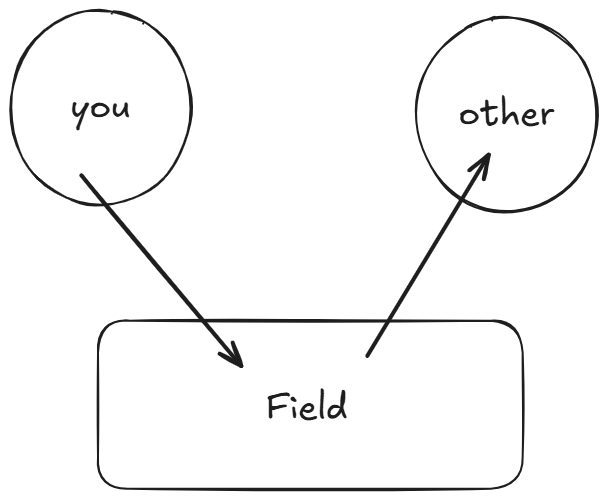
The figure shows a model in which the “psychological field” has a double function:
It is, firstly, the object toward which the actions of the subject are directed.
At the same time, it is, secondly, the instance from which effects on another person originate.
The subject in this model therefore does not interact directly with another person, but with a “field”, which in turn — according to its own laws — acts upon reality.
I oppose precisely this assumption.
🔹 Model B: Direct Interaction (my position)
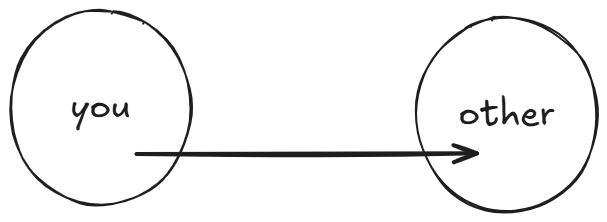
I assume that there is no independent mediating instance between subject and object.
The subject acts directly in the real world.
Interaction takes place directly between people.
What is called a “psychological field” is not an independent reality.
It can be understood as a description of the activity of the psyche, not as something that exists between people.
👉 Structure:
Subject → Action → other person
🔹 Central Difference
In the first model, an additional instance is introduced that mediates between subject and object and is itself effective.
In the second model, such an instance is abandoned:
The psyche produces a world model that determines the actions of the subject —
but the effects arise only through these actions in the real world.
The so-called “psychological field” is not an independent reality, but a conceptual construction for describing psychic processes.
Subjective World Model and Objective Reality
The world model as the content of the subject’s consciousness determines the actions of the subject on the physical level, but does not directly influence the real course of events itself.
Reality in this sense is objective and independent of the subjective world model.
The world model determines the actions of the subject on the physical level, but does not directly change objective reality; it affects objective reality only through the actions of the subject.
How does falling in love arise?
You can be perceived by other people only through your actions on the physical level.
Become attractive to others through your actions.