Why Wilhelm Reich Broke with His Relatives
The ESF Type on the Left Path
The type of Wilhelm Reich is ESF:
attitude toward the object — extraverted;
dominant function — extraverted perception of invariants (Se);
auxiliary function — extraverted feeling (Fe).
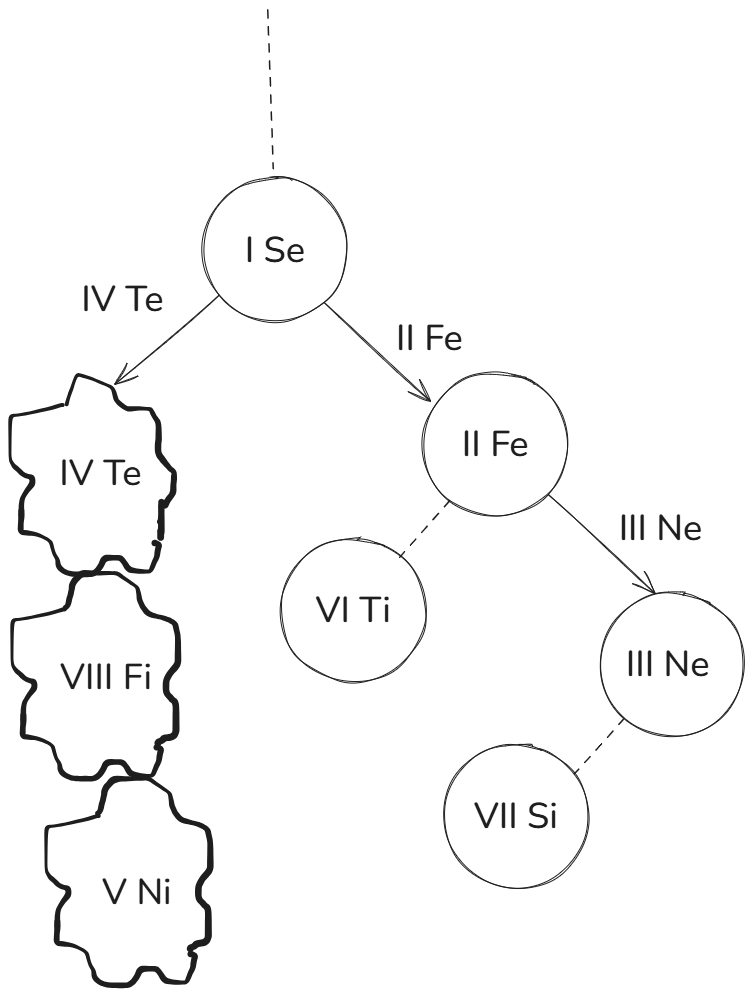
When Wilhelm Reich wrote his books, he was on the left path. I use this term to describe a state of consciousness in which only a single function is differentiated — the dominant function (Se — perception of invariants in extraverted attitude).
The functions of the right path — extraverted feeling (Fe), perception of changes (Ne), introverted thinking (Ti), as well as introverted perception of invariants (Si) — remain in the unconscious.
The consciousness of the ESF type on the left path is filled with undifferentiated content of extraverted thinking (Te), introverted feeling (Fi), and introverted perception of changes (Ni).
Carl Jung, however, assigned undifferentiated functions to the unconscious, while at the same time assuming that they break into consciousness and manifest themselves.
▶ Manifestation of undifferentiated functions
About irrational types Carl Jung wrote:
Their perception is directed toward what simply occurs as such, without being subjected to any selection by judgment. … They are highly empirical; they are based exclusively on experience, to such an extent that their judgment usually cannot keep pace with their experience.
However, such exclusivity of perception occurs only on the left path, where, in addition to the main irrational function, three undifferentiated functions are present in consciousness, merged with each other: both rational functions (judging functions) and the irrational function opposite to the main one.
On the left path, the dominant function is always the only differentiated function, and therefore it occupies an exclusive position in consciousness.
Carl Jung further writes about how undifferentiated rational functions (judging functions) manifest themselves in irrational types.
But the judging functions are nevertheless present; they merely lead a largely unconscious existence. Insofar as the unconscious, despite its separation from the conscious subject, repeatedly manifests itself, striking judgments and striking acts of choice also become noticeable in the lives of irrational types — in the form of apparent reasoning, cold judgment, and seemingly deliberate selection of people and situations. These traits bear an infantile or even primitive character; at times they are strikingly naive, at times ruthless, harsh, and violent.
It seemed to me that some passages from Wilhelm Reich’s book “Passion of Youth. An Autobiography. 1897–1922” illustrate the fusion of the functions of extraverted thinking (Te) and introverted feeling (Fi).
Extraverted thinking is the formation of conceptual judgments about concrete objects, and often these are judgments about income and expenses, or, for example, rules of good manners, or judgments about health benefits.
Feeling is also a judging function; its content consists of evaluations in the form of acceptance or rejection. Introverted feeling often devalues and rejects the object.
▶ Example: episode with relatives
After the war, at the age of 21, Wilhelm Reich became a student of medicine at the University of Vienna. About his choice of profession he writes:
…I was a completely uninformed student, one among thousands, without conscious aspirations for a better life, content with the hope of one day pursuing a respectable profession and making a living. I struggled for my material independence.
Wilhelm Reich tells of an incident that led to his break with his relatives. This episode is interwoven into the account of a poor and difficult student life.
Separation from the family went hand in hand with securing material self-sufficiency. In Vienna there lived brothers of my father, both not wealthy, but sufficiently well off materially, so that my brother and I could easily have been provided for. The remnants of our former assets were inaccessible.
Our homeland had fallen to Romania.
My father’s life insurance had become completely devalued.
Thus my brother and I were dependent on support. An aunt living in America once sent a few dollars. One of the two uncles, who was fond of us, from time to time gave a hundred Austrian crowns, which were at that moment being devalued. At first we occasionally ate with our relatives. But family attachment and sentimental enthusiasm look different in practice. The wives of the uncles preferred their own children. We were taking away from them the little they had during the years of hunger. It was embarrassing and bitter. One day one of the aunts served coffee to her children, and afterward poured me a second infusion. I knew that she would never have given that to her own children. I left without a word, slammed the door, and never saw the relatives again.
I understand the sense of offense of the young Wilhelm Reich, but I cannot help seeing in this episode an extreme ingratitude.
This is not simply a matter of lack of tact or emotional immaturity, but a complete distortion of the relation to the object: help is experienced as humiliation, and dependence as an insult.
Such feelings can be explained by the functional configuration of the ESF type on the left path, where both judging functions (both thinking and feeling) are not differentiated, and feeling in the introverted attitude has a devaluing character.
The fusion of extraverted thinking with introverted feeling can also explain the following passage from Wilhelm Reich’s book, in which he speaks about longing for his family in connection with food packages.
I lived in an unheated furnished room together with my brother and a student who later became a psychoanalyst. The fact that he from time to time received food from his mother I mention only because such events played a major role in the struggle I waged during those years with my own longing for my family.
Usually, longing for one’s family does not mean a desire to receive material support from the family; often it means the opposite — the desire to care for the family. This does not occur in the fusion of extraverted thinking with introverted feeling.
▶ Attitude:
marriage = sale
life = transaction
Previously, it seemed to me that such an attitude was characteristic of extraverted thinking in general. Now I understand that it is only possible in undifferentiated extraverted thinking fused with introverted feeling.
This fusion produces an attitude toward people depending on whether they can be used or not. And the same attitude is assumed in others toward oneself.
I was regarded as a promising physician, especially by my relatives. Before I broke with them, attempts were made to “marry me off advantageously.”
Wilhelm Reich suspected his relatives of hoping that he would soon become a successful and wealthy doctor and that being related to him would bring them benefits — as if they cared for him only because they expected that he would repay their care many times over.
Thus, I was supposed to escape the misery, which was very severe. It was not easy to say no. I lived for more than a year in abstinence, with occasional masturbation, and longed for a woman. But I wanted to be free and feared binding myself. For a short time I was engaged to a pretty girl, but she did not want to sleep with me, and she was not capable of intelligent conversation either. I left her. Two or three offers to “sell myself” I rejected after consideration.
It was not easy to say no, because feeling and thinking were undifferentiated.
What happens in the episode with the girl?
The object is evaluated negatively according to two parameters:
- sexual availability
- “intelligence” (not clearly defined)
But the question arises: why was he engaged to her at all?
This resembles an ambivalent attitude toward the object:
on the one hand, acceptance of the object (to the extent that the engagement took place),
on the other hand, rejection of the object (to the extent that Wilhelm leaves the girl).
And the fact that the offers to “sell himself” were rejected only after consideration makes me assume that these considerations consisted in weighing whether he might “sell himself too cheaply” if he did not “sell himself” at a sufficiently high price.
Thus, in this episode it becomes especially clear that the judging functions do not disappear, but only lose their differentiation.
They continue to operate, but in the form of sharp, abrupt, and seemingly rational decisions that are not accompanied either by elaborated thinking or by a genuine feeling-based relation to the object.